Dec 1, 2025
Restaurant marketing plan with practical steps to fill more tables

"Marketing" for a restaurant usually means boosting a social post and hoping it works. That’s a fast way to burn cash when margins are already razor-thin.
A solid marketing plan isn't a 50-page document you write once. It's a simple, one-page framework that turns random efforts into a reliable system for filling tables.
Think of this as your defense against slow nights. It’s a practical guide that forces you to stop guessing and start making strategic decisions that pack the house, even on a Tuesday. This process answers four straightforward questions.
This visual breaks down how these pillars connect.
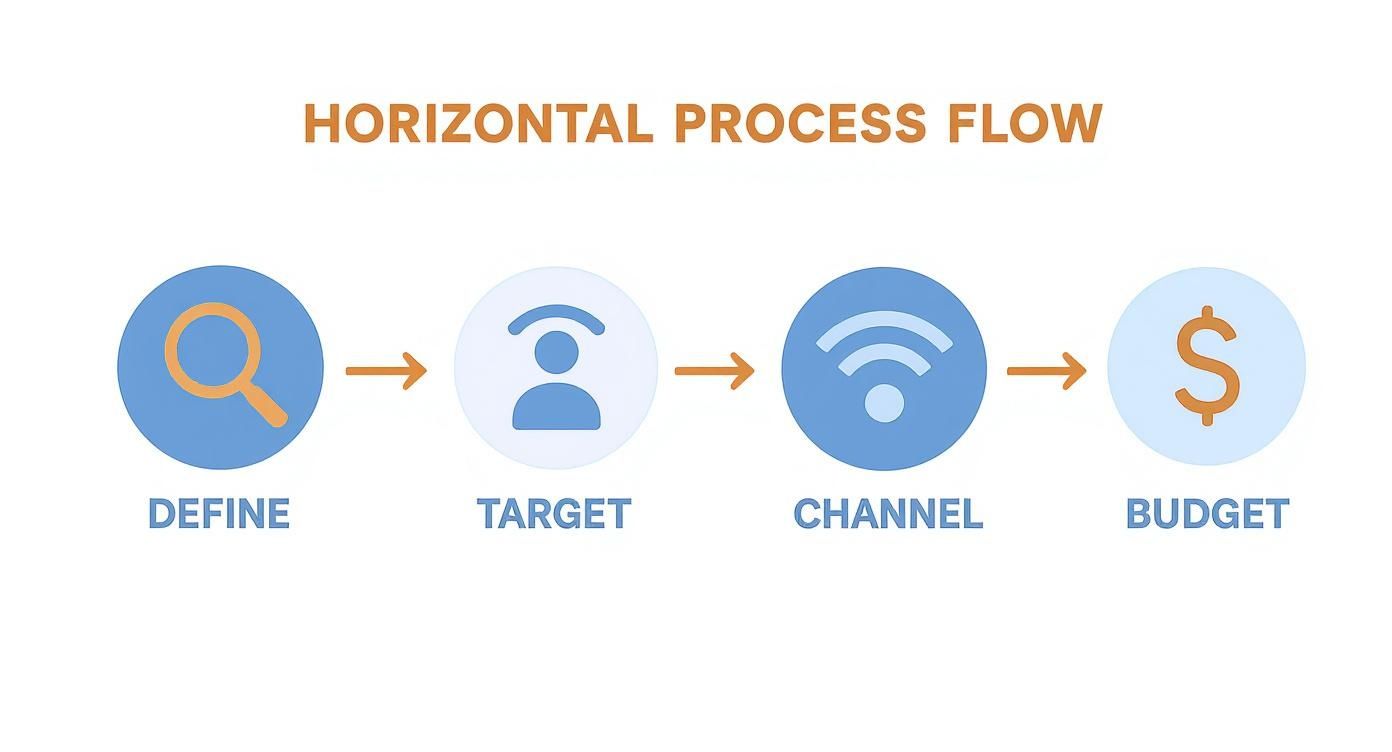
This step-by-step thinking ensures your marketing is purposeful, not just a series of disconnected promotions. To bring this together, here’s a snapshot of what your one-page plan might look like.
Before you spend a dollar on marketing, you need a clear picture of where your business stands. Marketing without data is like driving blind. A winning marketing plan starts by digging into your own POS data.
Forget vanity metrics like social media likes. Focus on the numbers that impact your bottom line. These are your Key Performance Indicators (KPIs), and they tell the real story of your restaurant's health.
Your POS system is a goldmine. Pull reports from the last quarter to establish a baseline. You can’t know if marketing is working if you don’t know where you started.
Essential KPIs to track:
Once you have these numbers, you can move from vague wishes to concrete objectives.
Quick Win: A goal like "get more customers" is useless. A goal like "increase weekday lunch covers by 15% this quarter by promoting our new express lunch menu" is a plan. It’s specific, measurable, and has a clear deadline.
With your baseline KPIs, set goals tied to revenue. This is how marketing shifts from an expense to an investment.
Each example connects a real business problem to a measurable marketing action. This ensures every campaign has a clear purpose.
Trying to be the restaurant for everyone is a way to be the go-to for no one. Great marketing plans get honest about who you’re trying to attract and why they should choose you.
This isn’t a branding exercise. Knowing your ideal customer and your unique edge informs every decision, from specials to Facebook ads.
You need a clear picture of your best customer, the one who comes back and tells their friends. Go deeper than demographics. Create a customer persona, a fictional profile of your ideal guest.
Building these personas forces you to think about the real-world problems you’re solving. Are you saving someone time? Providing a haven for parents? Each persona needs a different marketing message.
Face the economic realities your customers are dealing with. Data shows a shift in dining habits. Lower-income consumers are pulling back, while households earning over $100,000 now represent 43% of all diners, driving industry growth. You can discover more insights on how consumer demographics are shaping the industry to sharpen your strategy.
Once you know who you’re talking to, give them a reason to choose you. This is your Unique Selling Proposition (USP). It’s the one thing you do better than anyone else for that customer.
Your USP isn't a vague slogan like "Great Food, Great Service." It’s a specific, provable promise. It’s the answer to: "Why should I eat here instead of the ten other spots on this street?"
A great way to find your USP is to complete this sentence: "We are the only restaurant in [Your Area] that [Your Unique Benefit]."
Here are a few real-world examples:
Your USP becomes the backbone of your marketing. It should be on your website, in your social bio, and in your ads.
Now that you know who you’re talking to, where do you find them? Many owners spread their budget too thin across every platform and make no impact.
A smarter plan is to focus on a handful of channels where your ideal customers already are. The goal is to build a system where each channel supports the others. Your Instagram pulls people to your website, your website captures their email, and your emails bring them back.
Before spending on ads, get the fundamentals right. These channels cost more in time than money and deliver great returns.
While 57% of full-service restaurants now take online reservations, 79% still struggle to attract customers. This proves a smart marketing plan is what turns a digital presence into profit.
Don't let social media become a full-time job. Pick one or two platforms that make sense for your brand.
Dig into social media marketing strategies specifically for local businesses to sharpen your approach.
Your email list is one of the only marketing channels you truly own. You're not at the mercy of an algorithm change. It’s a direct line to your most loyal customers.
Start simple. Use a clipboard at the host stand or a sign-up form on your website. Send a monthly newsletter with updates and specials. This turns a first-time visitor into a regular.
Think about other local businesses that serve your ideal customer, like the gym down the street or the boutique around the corner.
Create win-win deals. Offer a discount for the gym's members, and they'll promote you. This builds authentic, word-of-mouth buzz that you can't buy.
Paid ads should be the last piece you add. Use them to amplify what's already working. Don't just "boost post." Use ads with a specific, measurable goal.
Start with a small budget, track your results, and only put more money behind ads that bring people through the door.
Deciding where to spend your time and money is tough. Here’s a quick cheat sheet to help you prioritize.
ChannelTypical CostEffort LevelBest For Attracting...Google Business ProfileFreeMediumLocal searchers ready to eat now.Email MarketingLowMediumRepeat customers and loyal fans.Local PartnershipsLow (often free)MediumWord-of-mouth referrals and community trust.Organic Social MediaFreeHighBuilding a brand personality and engaging followers.Local SEO / WebsiteLow-MediumHighCustomers actively researching places to eat.Paid Social/Search AdsScalable ($)MediumHighly targeted new customers with specific offers.Local PR / EventsMedium-HighHighBroader awareness and media buzz.
This table is about building a smart mix. Start with low-cost, high-impact options like GBP and email, then strategically layer in other channels as you grow.
A marketing plan is just an idea until you put it into action. You need a calendar to schedule everything and a budget to pay for it. This is where your strategy hits the ground, turning goals into a practical, day-to-day plan.
Think of your marketing calendar as your playbook for the next 90 days. Planning in quarterly sprints is more manageable than mapping out a full year. It’s about being proactive instead of reactive. No more waking up on October 1st with that sinking feeling that you have nothing planned for Halloween.
Your calendar doesn't need to be complex; a simple spreadsheet works perfectly. The point is to create a rhythm for your marketing so it becomes a consistent part of your operations.
Here’s a sample for a family-friendly bistro heading into spring:
This simple structure aligns all your marketing around a monthly theme, which makes everything feel cohesive and intentional.
How much should you spend? A good rule of thumb is 3-6% of your total revenue. If you’re a new spot, lean toward the higher end. An established restaurant can stick closer to 3%.
Stop thinking of marketing as just an expense. It's an investment designed to bring in more money. Every dollar you spend should be tracked with the expectation that it will generate a return.
Let's say your restaurant does $800,000 in annual sales. A 4% marketing budget is $32,000 per year, or about $2,667 per month.
Here’s one way to allocate that monthly budget:
Marketing ChannelMonthly BudgetPurposeGoogle/Facebook Ads$1,000Drive traffic for specific promotions like Easter Brunch or Happy Hour.Email Marketing Platform$67Nurture your VIP list with weekly specials.Local Partnerships$400Sponsor a local youth sports team or provide gift cards for a charity auction.Content & Photography$600Pay a photographer for one half-day shoot a month to keep social media fresh.Contingency Fund$600For unexpected opportunities or doubling down on a winning campaign.
This isn't about rigid rules; it's about having a game plan. When you track where every dollar goes, you see what's actually bringing people in.
A marketing plan isn't something you create and forget. The most important part is to measure results so you can stop guessing and start making decisions backed by data.
This is where the goals and KPIs you set earlier become your North Star. With help from your POS system and on-the-floor observation, you can create a feedback loop that separates the restaurants that thrive from those that just survive.
You don't need a PhD in data science to figure out what's working.
Block off 30 minutes once a month to review these numbers. The point is to spot trends and make quick, informed decisions. This turns your marketing plan from a static document into a dynamic tool for growth.
This regular check-in lets you confidently cut campaigns that aren't delivering a return on investment (ROI) and double down on the ones that are. If your email campaigns consistently drive repeat business, it might be time to build more robust customer loyalty programs for restaurants.
Understanding the basics of measuring social media ROI and other channels is critical. This feedback loop ensures every dollar you spend is working as hard as you are.
Here are a few common questions that pop up once you're executing your plan.
The classic rule of thumb is 3-6% of your total revenue. A new spot should lean toward the higher end to build momentum. An established restaurant focused on regulars can stick closer to 3%. The most important thing is to treat marketing as an investment. Track every dollar and double down on what works.
For most independent restaurants, the biggest bang for your buck comes from two places. First, master your local SEO by getting your Google Business Profile dialed in. Second, build an email list to drive profitable, repeat visits from your best customers. Once those two pillars are solid, social media and local partnerships become powerful ways to amplify that success.
Review your plan’s performance monthly for small adjustments, but do a more serious refresh each quarter. A monthly check-in keeps campaigns on track. The quarterly review is your chance to react to market shifts and plan for upcoming seasons and holidays. This rhythm keeps your plan from getting stale.
Ready to stop guessing and start knowing what marketing actually drives sales?
Peppr's POS and growth solutions gives you the clear insights you need to see which promotions are filling tables, helping you make smarter decisions and get a better return on every dollar you spend. See how Peppr can sharpen your strategy.

.avif)