Dec 12, 2025
Guide to restaurant equipment financing that breaks down loans and costs
Restaurant equipment financing is a way to get essential kitchen gear—ovens, coolers, POS systems—without paying the full price upfront. Instead, you make smaller, regular payments over time, freeing up cash for daily operations like payroll and inventory.
That new combi oven isn't just a shiny object. It’s an investment in your restaurant's speed and consistency. Better gear means faster ticket times, reliable food quality, and a chance to increase your covers per hour. But tying up thousands in working capital on one purchase can put you in a bind.
This is where smart restaurant equipment financing becomes a critical tool, not a last resort. It's a strategic move that separates thriving restaurants from those constantly scrambling.
In the restaurant business, cash is king. It pays your staff, keeps the lights on, and stocks your walk-in. When you drain your bank account to buy equipment outright, you leave yourself exposed. An unexpected HVAC repair or a slow Tuesday can become a crisis.
Financing keeps your cash reserve liquid and ready for the daily realities of running a restaurant. You get the gear you need to grow while keeping the financial flexibility to handle thin profit margins. Need help with the numbers? Check out our restaurant profit margin calculator.
Financing lets you jump on opportunities now. Instead of saving for a year to afford a new espresso machine, you can get it installed next week and start generating revenue. This approach turns a major capital expenditure into a manageable operating expense.
Key Takeaway: Think of financing as a tool for immediate ROI. The monthly payment for a new oven should be covered by the extra revenue from higher output and faster service.
The global restaurant equipment market is expected to grow from USD 92.89 billion in 2024 to USD 206.07 billion by 2035, as more operators use financing to get modern gear without the upfront hit. You can see the trend in these market growth projections. Smart financing helps you build a competitive, modern kitchen.
Not all financing is created equal. The wrong choice can lock you into high payments that bleed cash, while the right one can feel like a strategic partner. Picking the best path for your restaurant equipment financing means understanding the trade-offs between speed, cost, and ownership.
The equipment finance market is projected to grow from USD 1302.25 billion in 2024 to USD 1437.04 billion in 2025, showing a clear trend toward using financing as a growth tool. Dive deeper into equipment financing industry trends to see where the market is headed.
Let's break down the most common options.
This is the most straightforward route. A lender gives you cash to buy equipment, and you pay it back in fixed monthly installments over a set period, usually two to seven years. Once you make the final payment, the equipment is yours.
A lease is a long-term rental. You make monthly payments to use the equipment for a specific term. At the end, you can return it, renew the lease, or buy it for its market value. The core decision often boils down to the pros and cons of leasing versus buying equipment for your business.
Backed by the U.S. Small Business Administration, these loans offer favorable terms. The 7(a) and CDC/504 loan programs are ideal for major equipment purchases.
Insider Tip: SBA loans offer low interest rates and long repayment terms (up to 10 years for equipment), resulting in the lowest possible monthly payment.
The catch? The application process is notoriously slow, often taking weeks or months. It’s a great option if you can plan ahead, but not for when your fryer dies mid-shift.
An MCA provider gives you a lump sum of cash for a percentage of your future credit card sales. Repayment is deducted automatically from your daily batches.
Focusing only on the interest rate is a common mistake. The real cost of your restaurant equipment financing is in the details—fees, term length, and total cash paid out. A small difference in percentage points can add up to thousands of dollars.
Your rates and terms are tied to a few key factors.
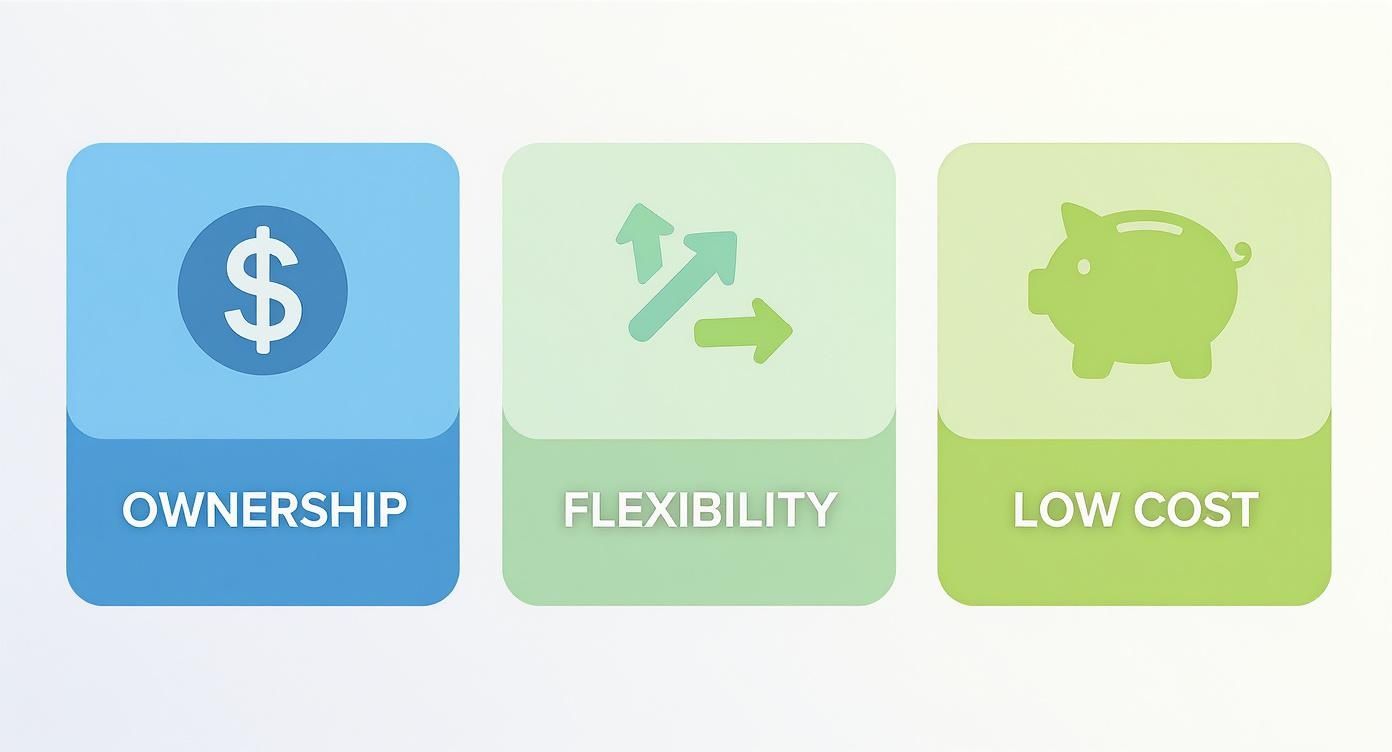
This visual highlights the trade-offs: loans prioritize ownership, leases offer flexibility, and certain options provide lower initial costs.
An equipment loan's cost is expressed as an Annual Percentage Rate (APR). A lease uses a "factor rate," a small decimal that can hide a higher true cost.
Key Insight: A lease factor rate is not an interest rate. You can't compare it directly to an APR.
To get a rough idea of the true cost, multiply your monthly payment by the term length to find your total repayment. The difference between that and the equipment price is your total financing cost. It's also important to remember technology costs. For a detailed breakdown, read our guide on how much a restaurant POS system costs.
Let's see how this plays out with a $20,000 combi oven financed over three years (36 months).
Scenario 1: Good Credit Bank Loan
Scenario 2: Alternative Lender Loan
Scenario 3: A Lease with a 0.038 Factor Rate
The lease with the innocent-looking factor rate is the most expensive option, costing nearly $5,000 more than the bank loan. Looking beyond the headline number is essential.
Showing up to a lender unprepared is the quickest way to get a "no." Get your paperwork in order before you start applying. Think of it like your prep list before dinner service. A buttoned-up application shows lenders you’re a serious, organized operator.
Get these scanned and saved in a digital folder.
Insider Tip: Write a one-page letter that tells the story behind the numbers. Context goes a long way. If you hit a rough patch, don't hide it—explain it. Showing how you navigated a real-world challenge is more impressive than pretending you’ve never had one.
The first offer a lender gives you is rarely their best. Negotiating the terms of your restaurant equipment financing is smart business that can save you thousands. Lenders are competing for your business, and a few strategic moves can shift the power in your favor.
The most effective negotiation tactic is getting multiple offers. Never talk to just one lender.
This competition forces lenders to put their best offer on the table.
Cash is leverage. Offering a bigger down payment reduces the lender’s risk, which can mean a better deal for you. Putting 20% down instead of 10% shows you’re financially stable. Use that to ask for something specific in return.
Negotiation Script: "If I increase my down payment from $2,000 to $4,000, can we get the APR down from 9% to 7.5%?"
Even a small rate reduction can save you a surprising amount over a multi-year term.
Read the fine print and look for terms that can cost you money later. A common one is the prepayment penalty, a fee for paying off your loan early. Ask the lender directly: "Does this loan have a prepayment penalty? Can we remove that clause?" For many lenders, especially when they know you have other offers, this is a negotiable point.
Your restaurant's equipment needs have evolved beyond just the kitchen. The technology that powers your front-of-house, like a modern POS and online ordering platform, is just as critical. The smartest operators bundle this tech into their main restaurant equipment financing package.
Frame your POS system not as software, but as the central nervous system of your business. It's the "equipment" that processes every dollar you earn. A system like Peppr is a revenue-driver, not just a cost center. It improves order accuracy, boosts online sales with commission-free ordering, and captures customer data for marketing.
Bundling everything shows lenders a complete, well-thought-out strategy. For more ideas, review restaurant technology solutions that boost profit.
Your financing request should tell a story of growth that connects every piece of equipment to your bottom line.
Example Pitch: "We're requesting $40,000. $25,000 is for a new combi oven to increase kitchen output by 30%. The other $15,000 is for a Peppr POS and online ordering system, which we project will boost takeout sales by 20%."
This approach proves you’re not just buying things; you’re investing in a more profitable restaurant. To stay ahead, explore the latest smart appliances for your restaurant. Financing both the hardware that cooks food and the software that sells it builds a stronger case for approval.
When you're diving into restaurant equipment financing, questions pop up. Here are straight answers to the most common ones.
Yes, you can. Most lenders will finance used equipment, but the terms may be stricter. You might see shorter repayment periods or a slightly higher interest rate because used gear is a bigger risk for the lender. Always get used equipment inspected by a professional before you sign any financing papers.
A personal credit score of 650 or higher is a solid benchmark for traditional lenders. If your score is lower, alternative lenders often work with owners in the 500-650 range, but you should expect higher rates. No matter your score, building strong business credit is always a smart move.
It varies depending on the lender.
If your walk-in dies and you need a new one yesterday, an online lender is your best bet.
Yes. Lenders view the equipment as collateral. Standard items like ovens and mixers are safe bets with a strong resale market. Highly specialized or custom-built equipment is riskier for them. A lender might ask for a larger down payment or a shorter term to limit their exposure on a unique item.
Ready to pair that new equipment with technology that drives growth? Peppr offers a modern POS and online ordering system designed for independent restaurants like yours. See how our tools can boost sales and simplify operations.

.avif)